From origin to opportunity.
KAVUNO helps Ugandan coffee exporters keep one honest record from the farm to the port: who grew the coffee, where, what was paid, and which export lot it became.
- Every farmer and plot on record
- Lots traced back to their farms
- Readiness checks before buyers ask
- Masaka store22,695 kg FAQ
- KampalaGraded, 11,904 kg Screen 18
- MombasaPort of loading
- HamburgGermany
From the demo dataset: 17 plots across Lwengo, Kyotera, Masaka filled lot KAV-LOT-2026-0037 with 11,904 kg of Robusta Screen 18. Line weight follows kilograms. Hover or focus a dot to see its district.
Why we built KAVUNO
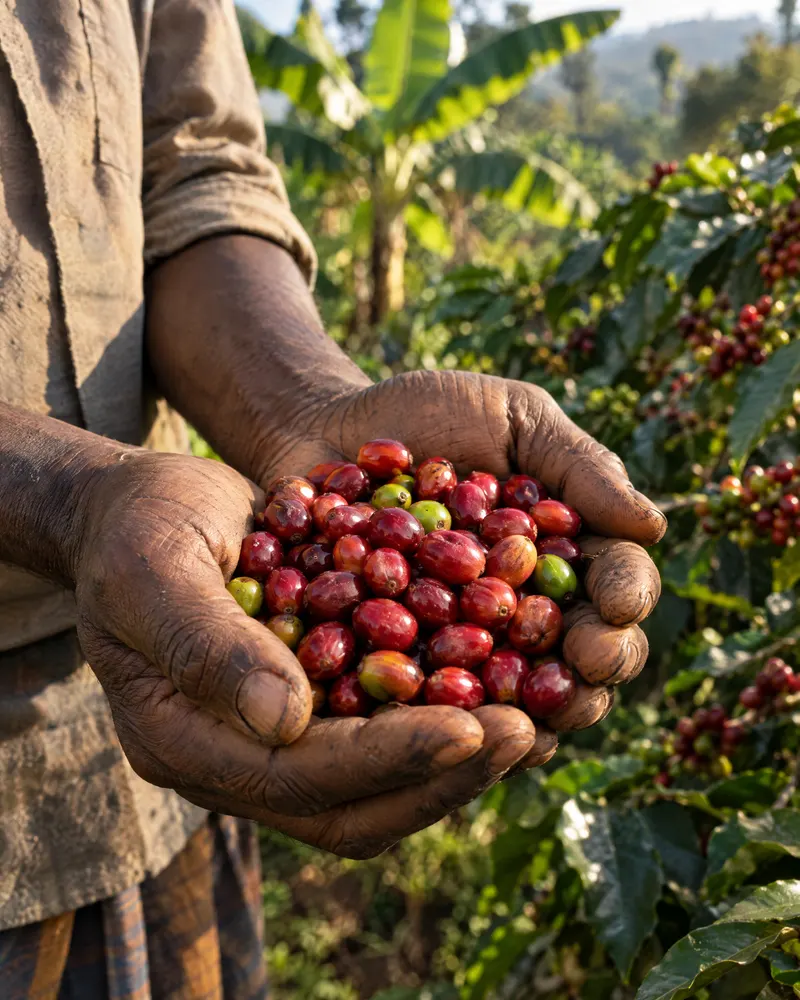
Ugandan coffee is grown on small family farms. Before it leaves the country it passes through many hands: a buying store, a truck, a grading plant, a warehouse and a port. Most of that journey is written on paper receipts and spreadsheets, and the farmer’s name usually disappears at the first bulking.
Buyers, especially in Europe, now ask exporters to show where each lot was grown. Rebuilding that answer from paper is slow, and gaps can cost a sale.
KAVUNO keeps the whole story in one record. Every kilogram stays linked to the farmer and plot it came from, so an exporter can answer a buyer with evidence, and the people who grew the coffee stay visible all the way to the port.
The name
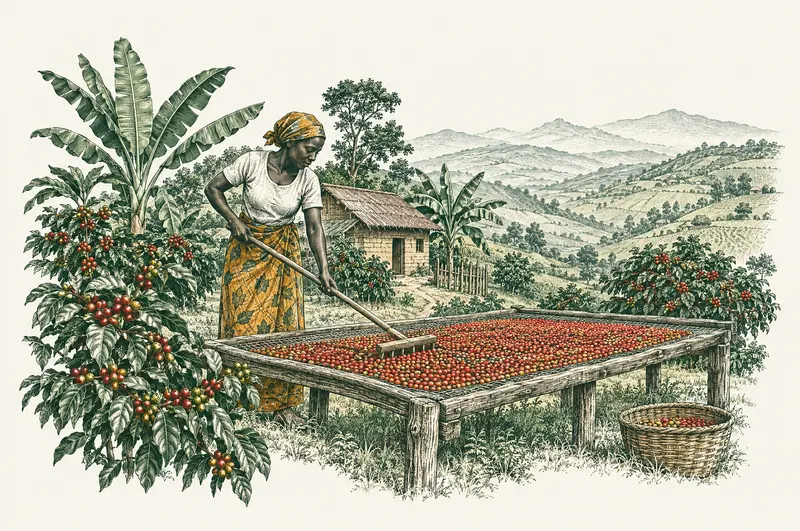
Kavuno means harvest. It is our spelling, drawn from Swahili farming words, because a harvest only becomes value when its story travels with it.
- Mavuno
- harvest, yield
- Kuvuna
- to harvest
- Kivuno
- harvest, yield, profit
What we believe
Farmers should stay visible. Every kilogram keeps the name and plot of the person who grew it, from the first receipt to the export lot.
Records should be honest. Numbers come from what was weighed, paid and recorded at the time, never from a form filled in later to satisfy a buyer.
Tools should fit the field. The phone app works one-handed, outdoors, at the scale, for field officers who register farmers and buy coffee every day.
Who it helps
- Exporters
- One view of procurement, stock, export lots and shipments, and an answer ready when a buyer asks where a lot came from.
- Field officers and store staff
- Quick farmer registration, plot mapping and purchase receipts on a phone, with the value worked out as the weight is typed.
- Farmers
- A receipt for every sale, consent recorded before any data is kept, and their name carried with their coffee.
- Buyers
- Lot-level evidence built from field records, with missing coordinates or documents shown plainly instead of hidden.
How it works
Four stages, one record. The coffee changes hands at every stage; the record does not. Each stage adds to what the one before it captured.
 1
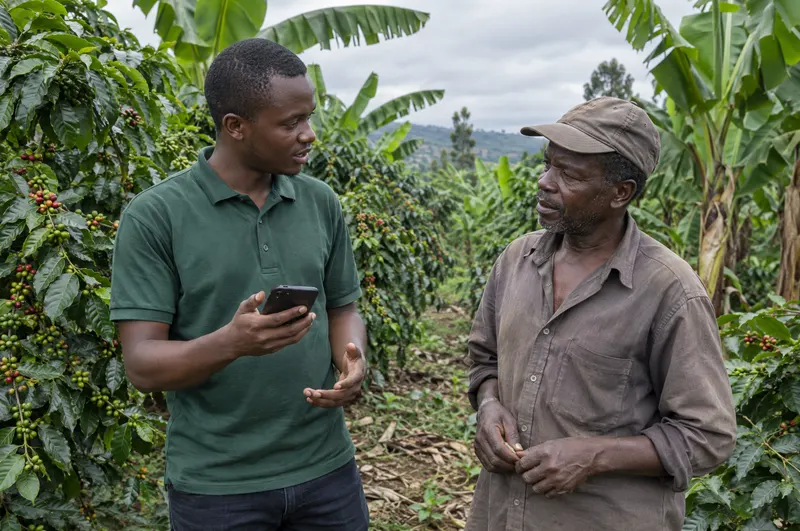
Register the farmer
A field officer records the farmer, their consent and the coffee plot, with its location, on a phone.
Who: field officer, on a phone
 2
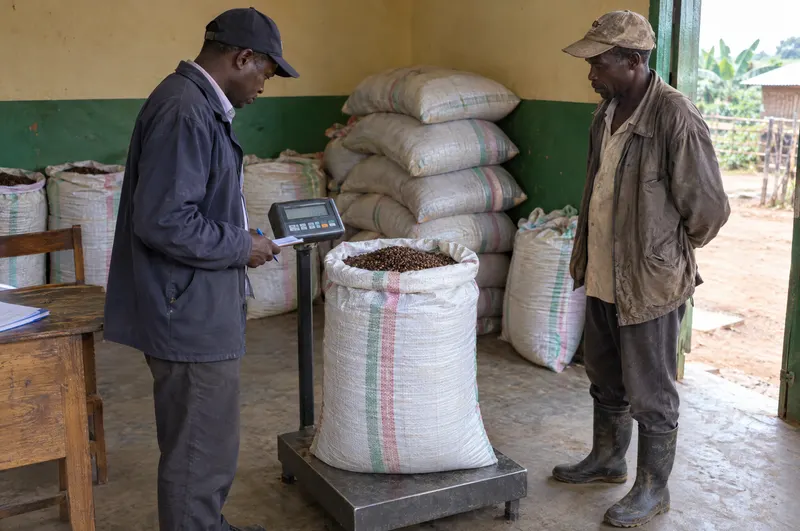
Buy and weigh
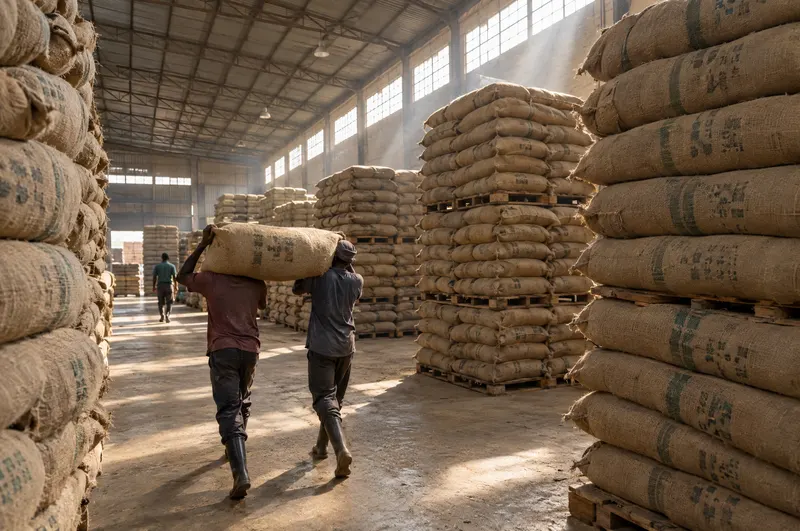
Coffee is weighed at the buying store and a receipt is issued. The receipt ties those kilograms to that farmer and plot.
Who: store buyer or agent
 3
Grade and build lots
Truckloads reach Kampala, are graded and bulked into export lots. Each lot keeps the list of every receipt inside it.
Who: warehouse and grading team
 4
Check, sell and ship
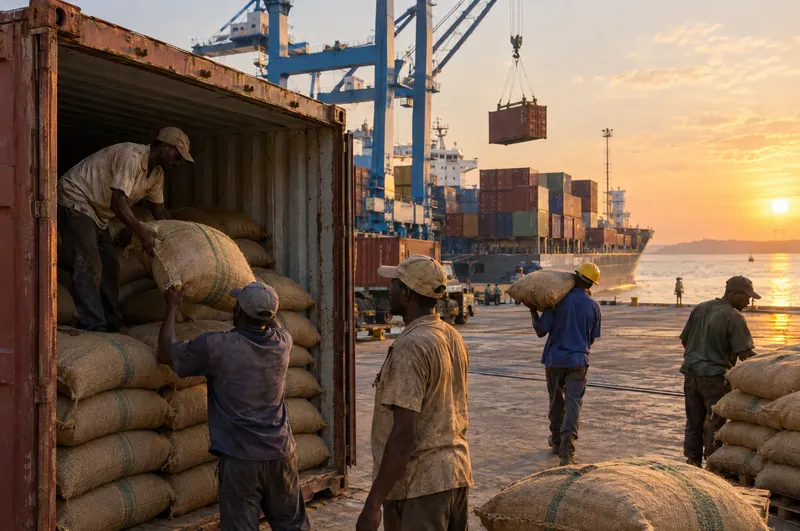
Readiness checks read the plot records, then the lot is allocated to a buyer's contract, loaded and shipped.
Who: compliance and export managers
Every step, with a real record
Up close, the four stages are eight steps. Each one below shows an actual entry from the demo dataset, and each one feeds the next.
Farmer
An enumerator registers the grower, records consent and maps the plot on a phone.
KAV-FR-MSK-0051Simon BbosaKabonera, MasakaPurchase
Coffee is weighed and bought as FAQ at a huller or agent store, and a receipt is issued.
KAV-RC-2026-003771,080 kg FAQUGX 12,906,000Store ledger
The FAQ is held at the store, in a ledger that keeps every receipt separate.
Masaka Town Agent StoreAgent store, Masaka+1,080 kg FAQ, 12 Aug 2026Truck to Kampala
FAQ from many farmers is loaded as one transport lot. Each bag keeps its receipt.
KAV-TL-2026-012622,695 kg FAQ28 purchases, 22 Sept 2026Grading
The plant grades and sorts the lot into several grades. Outputs plus loss always equal what came in.
KAV-GR-2026-012611,916 kg Screen 186,736 kg Screen 152,595 kg Screen 12Loss 1,448 kgExport lot
One grade is bulked from several runs and stored by grade. Every kilogram still points to a farmer.
KAV-LOT-2026-003711,904 kg28 receipts, 17 plotsReadiness review
Checks read the same plot and document records the field team created.
Ready for internal reviewScore 100 / 100Shipment
The lot is allocated to a contract, booked into a container and dispatched.
KAV-SH-2026-020MV Rwenzori Star to HamburgOn vessel
Follow this lot back to its farms
Lot KAV-LOT-2026-0037 is not a drawing. It resolves to 17 plots and 17 farmers through the receipts that filled it. 17 of 17 plots carry coordinates.
Trace it in the demo| District | Plot | Coffee | Mapping |
|---|---|---|---|
| Masaka | PL-0031-1 | 1,112 kg | Boundary mapped |
| Masaka | PL-0001-1 | 1,004 kg | Boundary mapped |
| Masaka | PL-0058-1 | 976 kg | Boundary mapped |
| Masaka | PL-0005-1 | 970 kg | Boundary mapped |
| Masaka | PL-0033-1 | 889 kg | Boundary mapped |
| Masaka | PL-0051-1 | 846 kg | Boundary mapped |
| Masaka | PL-0014-1 | 823 kg | Boundary mapped |
| Masaka | PL-0054-1 | 773 kg | Boundary mapped |
| Lot total, all 17 plots | 11,904 kg | ||
Every plot on a real map
The 17 plots behind lot KAV-LOT-2026-0037, the collection centres that bought their coffee and the road to the Kampala export store, over OpenStreetMap. Grey dots are the other 317 plots in the demo network. Zoom in to see plot boundaries.
- Plots in this lot (size follows kg)
- Other demo plots
- Huller and agent stores
- Kampala grading plant
Plot locations and boundaries are synthetic demo data placed near district centres; they are not survey or satellite records. Base map © OpenStreetMap contributors. Map tiles load from OpenStreetMap servers, which see your IP address; no cookies are set.
Readiness checks read the records, not a form
Before a buyer asks for a due-diligence pack, see which plots in a lot are missing coordinates, boundaries or documents. Fix the record and the check changes.
Illustrative readiness check only. Not a deforestation assessment, legal determination, official due diligence statement, government integration, or proof of EUDR compliance.
Checks on KAV-LOT-2026-0037 in the demo dataset
- Pass
Source traceability
Every kilogram in the lot links to a receipt, a farmer and a farm plot.
All 28 contribution lines link to a farm plot
- Pass
Plot geolocation
Each contributing plot has coordinates recorded in the field.
17 of 17 plots have coordinates
- Pass
Boundary polygon (plots over 4 ha)
Plots over 4 ha have a mapped boundary, not only a point.
Every plot that needs a boundary has one
- Pass
Supporting documents
Land tenure and a signed farmer declaration are on file and valid.
Land tenure and farmer declaration on file for every plot
- Pass
Flagged records
No supporting document is flagged for review.
No flagged documents
- Pass
Origin mix
Whether the lot mixes coffee from more than one region.
Single region, 3 districts
Built for the field, one hand free
Field agents register a farmer in three short steps and record a purchase standing at the scale. Large targets, the main action within thumb reach, and the value calculated as the weight is typed.
- Register a farmer and map a plot from the same screen
- Record a purchase with grade, moisture and price
- Receipt number issued and stock updated on save
Seven roles, one dataset
Each person is invited with one role and sees the screens their work needs, all reading the same records. The demo lets you sign in as any of them.
- Administrator
- Manages the team and sees every module
- Procurement
- Buys coffee and manages suppliers
- Warehouse
- Receives, grades and moves stock
- Compliance
- Keeps farm evidence and readiness reviews
- Exports
- Runs buyers, contracts and shipments
- Field officer
- Registers farmers and records purchases in the field
- Enumerator
- Registers farmers and maps plots only
Where KAVUNO stands today
It is
- An invite-only workspace for one exporter's team, with real sign-in and two-step verification
- Records kept in a database on a server, not in a browser
- Opening one module at a time, starting with team and account set-up
- Shown on this page with example records from the public demo
It is not
- Open for public sign-up
- Real farmers, buyers or prices on this page
- Live shipment or vessel tracking
- Integrated with any government or EU system, or proof of EUDR compliance
Talk to us about your lots
Contact details pending. Email, phone and address will be added before launch. Until then, try the demo or leave your address below.